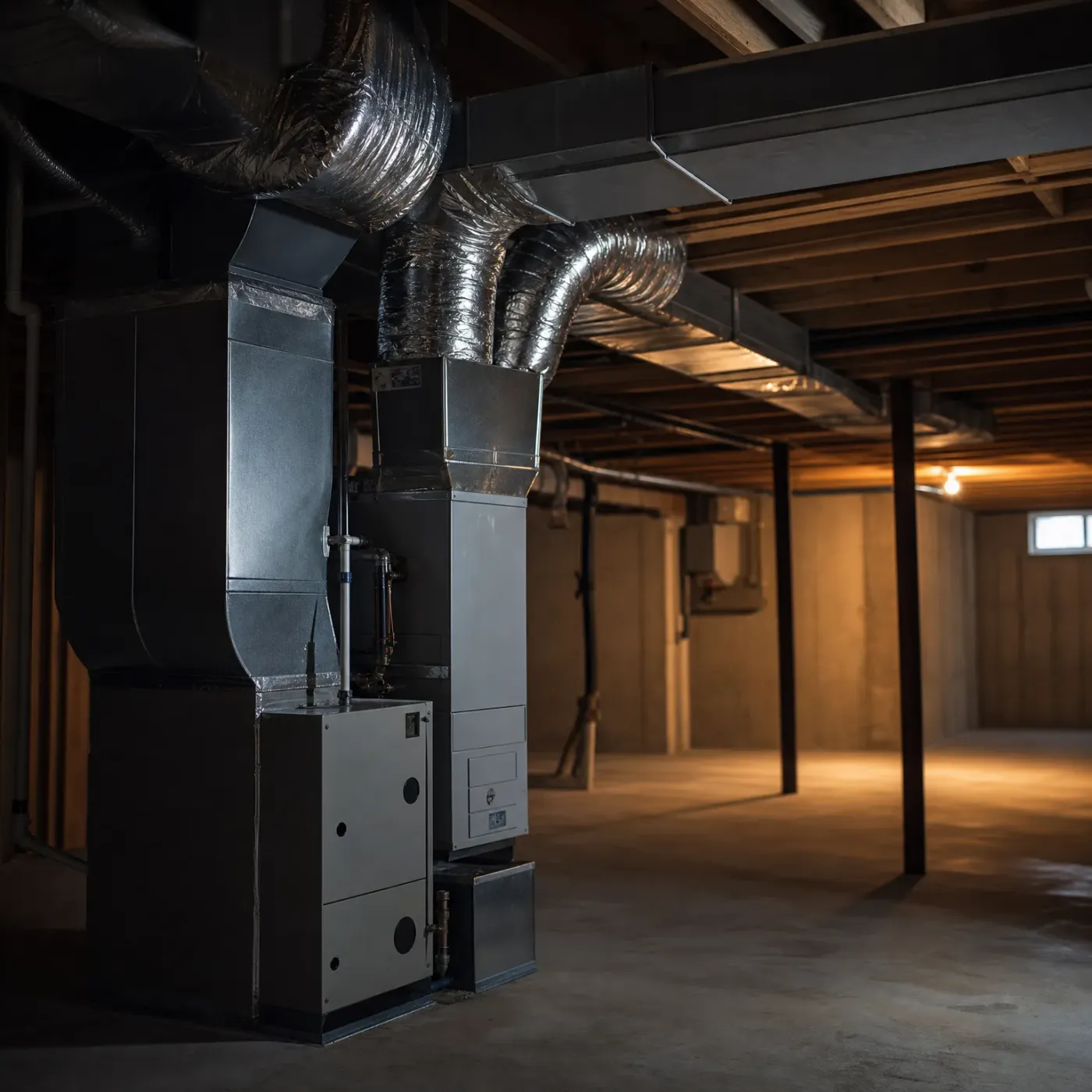
Unfinished basement with concrete floor and walls, exposed wood joists, steel support columns, and two furnace-type units connected to sheet-metal and flexible insulated ducts.

It's off your list after this

Why your vents smell musty in Montana

A musty smell from your vents usually means moisture sitting somewhere in the duct system, not just dust. With dry Montana summers and gas heat running most of the year, that smell points to something specific worth finding. This page gets into what's causing it. Send the form and stop chasing duct cleaners on your own.

Hand off the search

A musty smell from your vents usually means mold or mildew growing somewhere air passes through, most often the evaporator coil or the drain pan under it. Montana summers are hot and dry, so the air outside isn't the problem. The moisture comes from your own air conditioner. Every time it runs, it pulls humidity out of the air in your house and that water has to go somewhere. If the coil stays wet between cycles, or the drain line is slow to clear it, mold gets a damp surface to grow on and the smell spreads through the ducts every time the blower kicks on. Gas heat doesn't cause this, but once you switch over for winter, air still moves across whatever grew there over the summer. Cleaning the ducts and coil clears it out before it works into the insulation and the rest of the system.

Dusty sheet-metal HVAC ducts with a rectangular vent register run beneath wooden floor joists above an empty concrete-walled basement.
Before you get your ductwork cleaning
Empty basement with bare concrete walls and floor, a small window at left, and exposed wood joists with galvanized sheet metal ductwork and pipes overhead.
After you get your ductwork cleaning

Dust and debris build up where you can't see them

Ductwork runs behind walls and above ceilings. Dust, pet hair and old insulation collect inside and feed the mildew causing the smell, out of reach without opening the system up.
Send my request

One trip instead of searching on your own

Skip calling around, explaining the smell over and over, and sorting through quotes. Send the form once and let someone qualified take it from here.

Send my request

Leave It or Clean It Out

Smell comes back

  • The coil and drain pan stay wet after every cooling cycle, so anything growing there has a constant moisture source to feed on.
  • Dust sitting in the ducts holds onto that moisture and gives mold something to grow on besides the metal itself.
  • A closed-up house in the evening traps the smell instead of letting it air out through open windows.
  • Running the system more on hot days just pushes more of that musty air into every room.
  • Air fresheners and filter changes mask it for a day or two, then it's back because the source is still there.

Smell clears up

  • Cleaning removes the dust and buildup coating the ducts, coil and drain pan where the smell is coming from.
  • With the buildup gone, moisture has nothing to cling to, so it dries out between cycles instead of sitting there.
  • Air moving through the system picks up less of what was causing the smell in the first place.
  • One visit covers the whole system instead of treating the smell room by room as it shows up.
  • A gas furnace running most of the year pushes clean air through the house instead of recirculating the same problem.
Unfinished basement interior with exposed wooden floor joists, galvanized rectangular and round sheet-metal ducts, a gray furnace unit at left, and a large blank light-colored wall at right.

What that smell is doing to your air

Every time the blower kicks on, it pushes air across that wet coil and through ducts holding years of dust before it reaches your bedrooms and living room. Anyone in the house with allergies or asthma notices first. The smell is your signal, but the mold itself is what's circulating, cycle after cycle, through rooms where your family sleeps and spends most of its time.

Galvanized sheet metal ductwork with elbows and a vent grille running beneath an exposed wood joist and OSB ceiling, next to a blank white wall.

What it costs you if you wait

A coil caked with dust and grime does not move heat the way a clean one does, so your system runs longer to reach the same temperature. Longer runtimes with Montana's cheap power still add up over a summer. Left alone, the buildup can corrode the coil or clog the drain pan until it backs up. What starts as a smell can end as a repair bill for parts, not just a cleaning.

Power costs 12.99 cents per kilowatt-hour statewide

Cheap power at 12.99 cents a kilowatt-hour means running the blower longer isn't what costs you here. A full duct cleaning won't show up on your electric bill the way it might somewhere with pricier power, so there's no real tradeoff in getting it done right.

EIA-861 2025 statewide residential average

A smiling man in a dark green shirt over a white t-shirt sits at a kitchen counter with a dark mug, looking off to the side, with shelves, plants and a bright living area behind him.
A man in a gray long-sleeve waffle-knit shirt smiles and looks off to the side in a kitchen with open shelving, a refrigerator, a wooden sideboard with a potted plant, and a glass door to the right.
A man in a dark green ribbed sweater stands smiling and looking off to the side beside a stone kitchen counter with a ceramic mug, with a dining table, pendant lights, and large windows in the background.
A bearded man in a gray long-sleeve shirt stands smiling and looking off-camera beside a kitchen counter with a white mug, with a living room, fireplace and wall-mounted television behind him.

Send one request and you're done looking

Skip searching for a duct system pro and answer a few questions instead.

There's no charge for the request.

Catching it when it's just a smell

Right now it's a smell when the blower kicks on, nothing more. That's the easy version of this problem. A cleaning handles the dust and buildup feeding the mold before it spreads past the coil and drain pan into the rest of the ductwork. Deal with it at this stage and it's a single visit. You're not tearing into walls or replacing sections of duct, just clearing out what's already collected and taking away what the mold's been living on.

Waiting until it's worse than a smell

Leave it and the mold doesn't stay put. It keeps growing as long as the coil stays wet, and the dust sitting in your ducts gives it more surface to spread across. What started as a smell when the blower ran turns into something you notice standing in the hallway, or something that shows up as coughing and congestion for anyone with allergies. The cleaning itself doesn't change. What changes is how much has built up by the time someone does it, and how long you've been breathing it in the meantime.


A bearded man in a navy T-shirt sits on a light-colored couch indoors, smiling while looking down at a laptop screen in the foreground, with a framed picture and a potted plant blurred behind him.
A bearded man in a plaid flannel shirt stands indoors looking out a window at snow-covered conifers, with a ceramic mug on the wooden sill and wooden cabinets behind him.

What the smell tells you

  • A musty smell from your vents means moisture is feeding mold somewhere air moves through, usually the coil or drain pan.
  • Montana's dry summers rule out outside air as the source, so the moisture is coming from your own system.
  • Dust sitting in the ductwork gives mold something to hold onto besides bare metal, which is why the smell keeps coming back.
  • A duct cleaning clears the buildup feeding the problem before it spreads past the coil into the air you breathe.
  • Cheap power here means the blower running longer isn't costing you the way it would somewhere with pricier electricity.
  • Finding a contractor, checking who's licensed, and comparing quotes takes time you don't have to spend on a smell you already know the cause of.

The smell has a cause, and now you know what it is. Moisture sitting on the coil or in the drain pan, dust in the ductwork giving mold something to hold onto, and dry Montana air outside that was never the problem to begin with. None of that is a mystery anymore. It's also not something that fixes itself. The coil stays wet after every cooling cycle all summer, and the dust feeding the mold is still sitting in the ducts whether you deal with it this month or next year. A cleaning clears that buildup out before it spreads past the coil and into the air moving through your bedrooms and living room.

What's left is finding someone to do the work, and that's the part worth handing off. Instead of searching for contractors, calling a few, explaining the same smell and the same symptoms to each one, then sitting with quotes trying to figure out who's actually licensed to do this right, you send the details once. A contractor who handles duct cleaning in your area gets what you've already laid out here. You're not starting from scratch on the phone, and you're not the one doing the comparing. The smell doesn't go away on its own, but figuring out who's going to fix it isn't something you have to carry either.

A shingled two-story house with lit windows and stone accents at dusk, with a stone paver walkway and landscape lighting leading past ornamental grasses toward a calm bay under an orange and blue sky.

Ductwork Cleaning

Finding a pro stops being your job

Duct and vent cleaningDucts or ventsMontana
Step 1 of 2

What ZIP code is the job in?

  • A pale ceramic vase holding leafy green branches sits on a wooden side table beside a linen-covered chair with a throw blanket, below a wood-framed window.
    • A local pro who cleans ducts gets in touch with you.
    • Your duct cleaning request goes to a local pro who does this work.
  • A large woven basket with rope handles holding a draped cream fringed blanket stands in a room corner on a wood floor, with sunlight from a nearby curtained window and a dark wood cabinet at right.
    • Send the request and finding a pro stops being your problem.
    • After this form, you can stop searching for a duct system pro.
  • A leafy green plant in a woven basket sits in a sunlit corner beside a beige sofa with a knit throw, sheer curtains, a window, and a wooden coffee table.
    • Skip calling around for someone who cleans ducts.
    • Answer a few questions about the duct cleaning and skip the search.
  • A ceramic vase holding olive branches and a wooden bowl sit on a wooden windowsill beside a white-framed window, with a framed picture leaning against the grey wall.
    • Your duct cleaning request goes to one local pro.
    • Your request goes to one pro, not a list of companies.